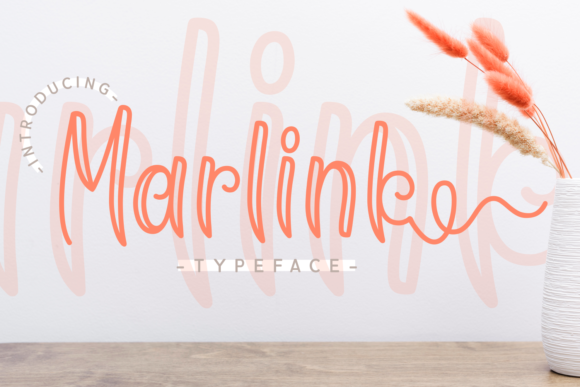
Marlink: A Handwritten Font That Builds Brand Warmth
As a marketing specialist who lives in Canva, Figma, and Adobe Creative Cloud, I don’t just pick fonts—I pick brand collaborators. Marlink isn’t another decorative script font you download and forget. It’s a handwritten font with rhythm, intention, and quiet confidence—designed to humanize digital touchpoints without sacrificing clarity or polish.
Visually, Marlink balances elegance and approachability. Its smooth, connected letterforms flow like confident pen strokes—not overly ornate, not stiffly uniform. There’s subtle variation in stroke weight, gentle entry/exit swashes, and generous spacing that keeps it legible even at smaller sizes. The mood? Thoughtful, sincere, and quietly luxurious—ideal for brands that want to signal care, craftsmanship, or personal connection.
Why Marlink Works Where Other Script Fonts Fail
Many handwritten fonts collapse on mobile screens, blur in YouTube thumbnails, or vanish in fast-scrolling Instagram feeds. Marlink avoids those pitfalls because its x-height is generous, its lowercase forms are distinct, and its baseline consistency supports rapid reading—even at 24px on a 320px-wide preview. That makes it unusually versatile for a script font: effective as a headline, a logo mark, a callout in a digital ad, or a subtle accent in a branded email header.
It performs especially well in contexts where emotional resonance matters more than neutrality: wedding-related campaigns, boutique skincare launches, artisanal food branding, coaching programs, and small business storytelling. When your audience sees Marlink, they don’t just read the words—they feel the intention behind them.
Real Campaign Uses—Not Just Mockups
Here’s how Marlink shows up in actual marketing workflows:
- Sale announcements: Paired with a clean sans serif (like Inter or Montserrat), Marlink sets the “limited-time” headline while body copy stays scannable—ideal for Instagram Stories and email banners.
- Webinar or event covers: Used for the title only, with a muted background photo and tight kerning, Marlink adds warmth without competing with facial expressions or key visuals.
- Pinterest quote pins: Its natural rhythm guides the eye down the page—especially effective when overlaid on soft-textured backgrounds or lifestyle photography.
- Reels covers and Shorts thumbnails: At 48–64px size, Marlink holds up across devices. Use it for a single powerful word (“Yes”, “Now”, “You’re Invited”) to stop mid-scroll.
- Landing page hero sections: Combine Marlink for the headline with a light-weight serif (e.g., Lora) for subheadings—creating contrast that feels editorial, not chaotic.
- Branded Canva templates: Designers use Marlink for editable title placeholders in client-facing kits—adding premium perception without over-designing.
Strategic Font Pairing for Consistent Brand Voice
Marlink shines brightest when paired intentionally—not randomly. As a display font, it’s rarely used for long paragraphs. Instead, treat it as your brand’s “voice highlighter.” For social media graphics, pair it with a neutral sans serif (e.g., Poppins or Open Sans) for captions, CTAs, and data points. That contrast builds visual hierarchy while reinforcing tone: warm + trustworthy, personal + professional.
For print-adjacent digital assets—like newsletter headers or digital lookbooks—try pairing Marlink with a low-contrast serif (e.g., Playfair Display or Cormorant Garamond). This combo signals sophistication without pretension, especially for creative services, publishing, or lifestyle brands.
Readability First—Even in Tiny Previews
Remember: your audience doesn’t pause to admire typography. They scan. So when using Marlink, prioritize context over decoration. Avoid all-caps usage—it disrupts the natural flow of the script. Stick to sentence case or title case for best legibility. On mobile, keep headlines above 32px; for thumbnails under 200px wide, limit Marlink to one line and no more than five words.
Also avoid stretching or distorting the font in design tools—Marlink’s charm lives in its organic proportions. If you need bold impact, use its built-in bold weight (if available) or layer it subtly over a solid color block—not by applying artificial bolding or outline effects.
Commercial Use & Licensing Essentials
Marlink is a premium font from the Script Amp category—meaning it’s crafted for expressive, high-impact applications. Before deploying it in ads, client deliverables, Shopify banners, or downloadable templates, verify its commercial license. Most reputable vendors include clear terms for web embedding, SaaS platforms, and resale in design assets—but always double-check. Using an unlicensed font in paid campaigns risks takedowns or legal exposure, especially at scale.
That said, when properly licensed, Marlink becomes part of your brand’s visual grammar—not just decoration. It helps unify campaign visuals across Meta, Pinterest, email, and web without needing custom illustrations or bespoke lettering each time.
When to Reach for Marlink—and When to Pause
Reach for Marlink when you need to:
- Add authenticity to a launch announcement for a founder-led brand
- Softening a tech or finance brand’s tone for a community initiative
- Creating seasonal content (e.g., holiday cards, spring collection teasers)
- Designing a personal branding kit for coaches or creatives
- Elevating product packaging mockups or digital shelf assets
Pause before using Marlink for:
- Long-form website body text or blog posts (stick with a highly readable serif or sans serif)
- UI elements like navigation menus or form labels
- Brands with strict corporate identity guidelines requiring monoline or geometric typefaces
- High-contrast accessibility requirements—always test against WCAG contrast ratios if used over imagery
Marlink isn’t about trend-chasing. It’s about choosing a typeface that aligns with how your audience wants to feel—not just what they need to know. In a feed saturated with AI-generated visuals and algorithm-optimized templates, a thoughtful handwritten font like Marlink becomes a quiet differentiator. It says: *we made this with care*. And in marketing, that kind of sincerity still converts.